
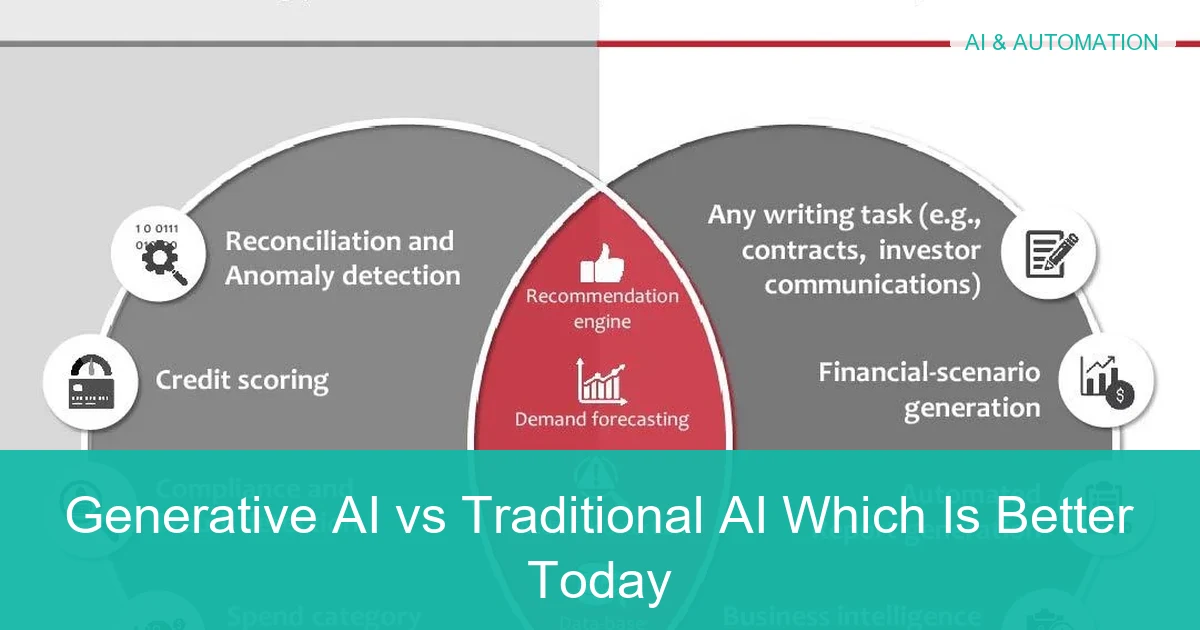
Generative AI vs Traditional AI Which Is Better Today
Traditional AI is usually better for structured prediction, classification, and compliance-heavy automation. Generative AI is usually better for drafting, summarizing, brainstorming, and conversational support.
Generative AI and traditional AI are often discussed as if they are competing technologies, but in practice they solve different problems. The better choice depends on whether you need prediction and control, or creation and flexibility.
- Traditional AI: Best for predictable, measurable decisions.
- Generative AI: Best for content, ideas, and language tasks.
- Best practice: Use both together when workflows need accuracy and flexibility.
- Main risk: Generative AI can sound right while being wrong.
- Decision rule: Choose based on task, risk, budget, and review needs.
Generative AI vs Traditional AI: What the Terms Mean in 2026
In 2026, the phrase generative AI vs traditional AI usually refers to two broad approaches. Traditional AI is built to recognize patterns, classify data, or make predictions, while generative AI is designed to produce new text, images, code, audio, or other content based on learned patterns.
That difference sounds simple, but it changes how each system is trained, evaluated, and used. Traditional AI tends to answer questions like “Is this fraudulent?” or “Will demand rise next month?” Generative AI is more likely to answer “Write a summary,” “Draft an email,” or “Create a concept sketch.”
How each type of AI works in practice
Traditional AI often uses machine learning models that learn from labeled examples or historical data. The goal is usually to predict a category, score, or future outcome with consistent rules and measurable performance.
Generative AI learns statistical patterns from large datasets and then produces new outputs that resemble the data it was trained on. It can draft paragraphs, suggest designs, or generate code, but the output is not guaranteed to be factually correct unless it is checked.
Why the distinction matters for business and personal use
The distinction matters because the wrong tool can create avoidable risk. If you need reliable classification or a repeatable decision process, traditional AI is often the safer fit. If you need speed, brainstorming, or natural-language interaction, generative AI may save far more time.
For everyday users, this also affects trust. A chatbot may sound confident even when it is wrong, while a prediction model may be less flashy but more dependable for structured tasks.
Generative AI vs Traditional AI: Key Differences That Affect Results
Comparing these systems only by popularity misses the practical details. The biggest differences show up in the data they use, the kind of output they produce, and how easy they are to trust in real workflows.
Data input, training style, and output type
Traditional AI usually works with structured inputs such as numbers, categories, sensor readings, or transaction histories. It is commonly trained to map those inputs to a known output, like a risk score or a yes/no decision.
Generative AI is often trained on much broader data, including text, code, images, or mixed formats. Its output is open-ended, which makes it useful for creative or language-heavy tasks, but also harder to constrain.
Accuracy, predictability, and explainability
Traditional AI is usually easier to test because the output space is narrower. If a model predicts whether a payment is suspicious, the result can be checked against known outcomes and tuned over time.
Generative AI can be highly useful while still being less predictable. It may answer the same question differently from one prompt to the next, and it can produce plausible but incorrect information. That is why human review still matters, especially for important decisions.
Explainability varies by model and setup. Some traditional models are easier to interpret than others, and some generative systems can be paired with retrieval or guardrails to improve reliability.
Speed, scalability, and flexibility
Both approaches can scale well, but they scale in different ways. Traditional AI is often efficient for repeated decisions at high volume, while generative AI is flexible enough to handle many prompt-based tasks without rebuilding the model for each new use case.
That flexibility is powerful, but it can also increase operational complexity. Teams may need prompt rules, content filters, review steps, and monitoring to keep outputs useful and safe.
| Option | Best For | Watch Out For |
|---|---|---|
| Traditional AI | Prediction, classification, scoring | Less flexible for open-ended tasks |
| Generative AI | Drafting, summarizing, brainstorming | Hallucinations and inconsistent answers |
When Traditional AI Is the Better Choice
Traditional AI is usually the better fit when the task is structured, repetitive, and sensitive to errors. In those cases, a narrower model with clear performance metrics can be more practical than a system that sounds smart but may improvise.
High-precision tasks like fraud detection, forecasting, and quality control
Fraud detection, demand forecasting, and quality inspection all depend on pattern recognition with measurable outcomes. These are classic traditional AI use cases because the model can be trained on historical examples and judged against objective results.
For example, a manufacturing line may use a vision model to flag defects, or a finance team may use a scoring model to identify unusual transactions. In both cases, consistency matters more than creativity.
Compliance-heavy workflows and regulated industries
In regulated environments, explainability and auditability often matter as much as accuracy. Traditional AI can be easier to document, validate, and monitor, which is one reason it remains important in healthcare, finance, insurance, and similar fields.
If a decision affects legal exposure, customer rights, or safety, ask an expert before deploying any model. The right implementation depends on industry rules, internal governance, and the consequences of a wrong answer.
Cost-efficient automation for repetitive decision-making
When the same decision must be made thousands of times, traditional AI can be a cost-effective automation layer. It is often more efficient than using a generative system to interpret every case through a free-form prompt.
That said, cost should include maintenance, monitoring, and retraining. A cheaper model can become expensive if it needs constant manual correction or if its data pipeline is weak. [Source: Wikipedia]
When Generative AI Is the Better Choice
Generative AI is strongest when the output needs to be original, conversational, or fast to produce. It is especially helpful when people want a starting point rather than a final decision.
Content creation, summarization, and conversational support
Generative AI is a natural fit for drafting blog outlines, rewriting messages, summarizing long documents, and powering chat-based support. It can reduce the time spent on first drafts and help teams respond faster.
For support teams, it can also turn a knowledge base into a more conversational experience. Still, any customer-facing answer should be reviewed when the stakes are high or the topic is technical.
Design, ideation, and rapid prototyping
When teams need many ideas quickly, generative AI can speed up early-stage work. It can suggest product names, copy variations, wireframe concepts, or code snippets that help teams move from blank page to rough prototype.
This makes it especially useful in creative workflows where “good enough to explore” is more valuable than “perfect on the first try.” The key is to treat the output as a draft, not a final authority.
Many organizations get the best results by combining generative AI with retrieval from trusted internal documents, rather than letting the model answer from memory alone.
Knowledge work that benefits from natural-language interaction
Generative AI is especially useful for work that depends on reading, writing, and explaining. People can ask it to rephrase a policy, turn notes into a summary, or translate a technical idea into simpler language.
That ease of interaction lowers the barrier for nontechnical users. Instead of learning a complex interface, they can work in plain language and iterate quickly.
- Fast drafting and summarization
- Flexible natural-language interaction
- Useful for brainstorming and prototyping
- Can produce wrong or invented details
- Needs guardrails and review
- Less predictable than structured models
Real-World Use Cases: Where Businesses Use Both Together
In many companies, the real answer is not either/or. Traditional AI and generative AI often work best as a combined system, each handling the part it does best.
Customer service teams combining chatbots with generative assistants
A support workflow might use traditional AI to route tickets, detect intent, or identify urgency. Then generative AI can draft a response, summarize the case, or suggest next steps for the agent.
This combination keeps the process structured while still improving speed and tone. It is often more effective than using a fully open-ended chatbot for every customer issue.
Marketing teams using generative AI for drafts and traditional AI for targeting
Marketing teams may use generative AI to create ad copy, landing page drafts, or social captions. Traditional AI can then help with audience segmentation, lead scoring, or campaign performance prediction.
That split is practical because creative work and targeting work have different requirements. One needs ideas; the other needs reliable pattern recognition.
Operations teams pairing prediction models with AI-generated reports
Operations teams often rely on traditional AI for forecasting inventory, staffing, or demand. Generative AI can then turn those outputs into readable reports, executive summaries, or action lists.
This saves time without replacing the underlying prediction model. It also makes technical insights easier for nontechnical stakeholders to understand.
Cost, Risk, and ROI: Which AI Approach Is More Practical Today
Practicality is not just about model quality. It also includes implementation effort, maintenance, governance, and the cost of mistakes.
Implementation and maintenance costs
Traditional AI can be less expensive when the problem is narrow and the data is clean. But it may require careful feature engineering, retraining, and monitoring to stay accurate as conditions change.
Generative AI can be quicker to prototype, especially when using hosted tools or APIs. However, usage costs, prompt management, output review, and safety controls can add up over time.
Hidden risks: hallucinations, bias, and model drift
Generative AI can hallucinate, meaning it may generate confident but false information. Traditional AI is not immune to bias or error either, but its failure modes are often easier to measure in a controlled task.
Both approaches can also drift over time if the data changes. That is why monitoring and periodic review are essential, especially when models influence customers, money, or compliance decisions. [Source: EPA]
Do not assume a polished answer is a correct answer. Generative AI can sound persuasive even when it is wrong, so important outputs should be checked against trusted sources.
How to evaluate ROI beyond upfront pricing
ROI should include time saved, error reduction, user adoption, and the value of better decisions. A tool that costs less upfront can still be a poor investment if it creates review bottlenecks or customer risk.
For a fair comparison, measure how much work the system removes, how often humans must intervene, and what happens when the model fails. If the impact is high or the workflow is complex, ask an AI implementation expert or consultant before making a final choice.
Common Mistakes People Make When Choosing Between the Two
Many AI projects fail because teams start with the technology instead of the problem. The better approach is to define the task first, then choose the model that fits it.
Using generative AI for tasks that require strict accuracy
Generative AI is a poor default choice for legal, financial, medical, or safety-critical answers unless it is tightly controlled and reviewed. Even then, it should usually support human decision-making rather than replace it.
Overengineering traditional AI for creative workflows
Some teams spend too much time building a rigid prediction system for a task that really needs drafts, ideas, or conversational help. In those cases, generative AI may deliver value faster and with less complexity.
Ignoring governance, human review, and data quality
No AI system performs well if the data is poor or the workflow is unmanaged. Clear approval steps, quality checks, and ownership matter just as much as model choice.
- Match the model to the task
- Review outputs for high-stakes use
- Keep data clean and current
- Use generative AI as a truth machine
- Assume traditional AI is always more accurate
- Skip governance because a demo looks good
How to Decide Which Is Better for Your Needs in 2026
There is no universal winner in the generative AI vs traditional AI debate. The better option depends on your goal, your budget, and how much risk you can tolerate.
Decision criteria based on business goal, budget, and risk tolerance
Choose traditional AI if your goal is prediction, classification, or repeatable decision-making with clear metrics. Choose generative AI if your goal is writing, summarizing, ideating, or conversational assistance.
If your budget is limited, start with the smallest tool that solves the problem. If the workflow is high-risk, prioritize explainability, review, and governance over convenience.
- Is the task structured or open-ended?
- Do you need accuracy, creativity, or both?
- How costly is a wrong answer?
- Will humans review the output?
- Can the model be monitored over time?
When to seek expert help from AI consultants or implementation teams
Ask for expert help when the project affects compliance, customer safety, sensitive data, or major business operations. You should also involve specialists if you need integration with existing systems, custom model tuning, or formal risk review.
An expert can help you avoid expensive mistakes such as choosing the wrong architecture, underestimating maintenance, or deploying a model without proper controls.
Final recap: choosing the right AI for the right job
Traditional AI is usually better for structured, high-precision, and compliance-sensitive work. Generative AI is usually better for content, conversation, and creative acceleration.
The smartest teams in 2026 do not pick one camp forever. They use each type where it fits best, and they keep humans involved where accuracy and judgment matter most.
Frequently Asked Questions
Traditional AI is usually built to predict, classify, or score data. Generative AI is designed to create new content such as text, images, code, or summaries.
Not always. Generative AI is better for creative and language-heavy tasks, while traditional AI is often better for structured, high-precision decisions.
Accuracy depends on the task and the model. Traditional AI is often more predictable for narrow workflows, while generative AI can be useful but may produce incorrect or invented details.
Yes, and many do. Traditional AI can handle prediction or routing, while generative AI can draft responses, summaries, or reports.
Avoid using it alone for tasks that require strict accuracy, legal review, medical judgment, or safety-critical decisions. Those cases usually need human oversight and stronger controls.
Start with your goal, risk level, and budget. Use traditional AI for structured decisions and generative AI for creative or conversational work, then add human review where needed.
