
What Is Deep Learning Explained Simply for Beginners
Deep learning is a type of machine learning that learns patterns from data using layered neural networks. It is useful for complex AI tasks like image recognition, speech, and generative tools, but it needs good data and enough computing power.
Deep learning is a type of AI that helps computers learn patterns from large amounts of data, then use those patterns to make predictions or generate outputs. In simple terms, it is one of the main technologies behind many modern tools people use every day, from photo search to chatbots.
If you are new to AI, the easiest way to think about deep learning is as a layered learning system. Instead of being programmed with every rule, it learns from examples and improves as it sees more data. For a broader look at how AI fits into everyday systems, you may also find our guide on improving video call quality useful, since many modern platforms now use AI-driven features behind the scenes.
- Definition: Deep learning learns from examples using multi-layer neural networks.
- Best fit: It works well for complex, unstructured data like images, audio, and text.
- Trade-off: It often needs more data, compute, and maintenance than simpler models.
- Business value: It supports automation, prediction, and generative AI workflows.
- Beginner tip: Start with a simple baseline before jumping into deep learning.
What Is Deep Learning? A Simple Definition for Beginners
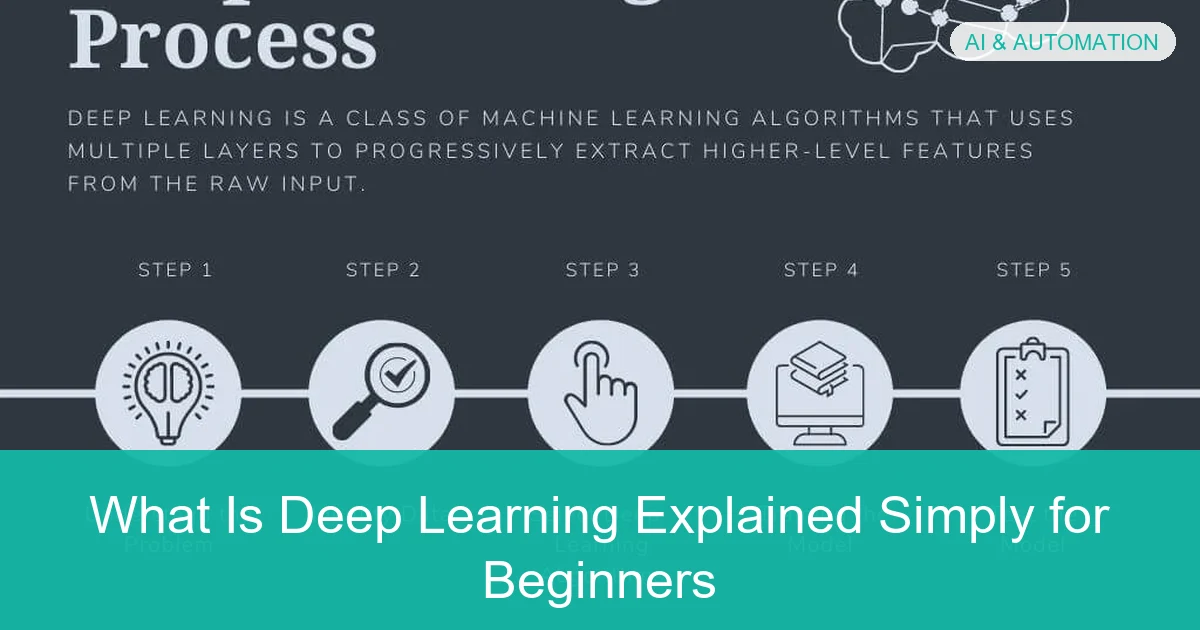
Deep learning is a method of machine learning that uses layered neural networks to find patterns in data. The “deep” part refers to the many layers the model uses to process information step by step.
Each layer learns something slightly different. Early layers may detect simple features, while later layers combine those features into more useful conclusions. That is why deep learning works well for tasks like recognizing faces, understanding speech, and generating text.
How Deep Learning Works Behind the Scenes
Deep learning systems are trained on examples. During training, the model makes guesses, checks how wrong those guesses are, and adjusts itself to improve over time.
This process repeats many times. The model gradually changes internal values so it can produce better results the next time it sees similar data. That is why training can take time and why results depend heavily on the quality of the training set.
Neural networks, layers, and weights explained in plain English
A neural network is a computer system inspired by how the brain handles information, though it is much simpler than a real brain. It is made up of connected layers of small units that pass information forward.
The connections between those units have weights, which are numbers that control how strongly one piece of information influences the next. During training, the model changes those weights to reduce errors.
You can think of it like tuning a huge set of dials. At first, the dials are random. After training, many of them are adjusted so the model becomes better at the task you want it to do.
Neural networks are not magic and they do not “understand” the world the way humans do. They are pattern-recognition systems that can be very effective when the task and data are a good match.
Why “deep” matters: from shallow models to multi-layer learning
Older or simpler models often use only a few steps to make decisions. Those can work well for straightforward problems, especially when the data is structured and the pattern is easy to learn.
Deep learning uses many layers, which helps it learn more complex relationships. This is especially useful when the input is messy or high-dimensional, such as images, audio, video, or natural language.
That extra depth is also why deep learning usually needs more data and more compute than simpler methods. More layers can mean more power, but also more cost and more room for error.
Deep Learning vs Machine Learning vs Traditional AI
People often use these terms interchangeably, but they are not the same. Traditional AI is a broad category that includes rule-based systems, while machine learning is a subset that learns from data, and deep learning is a subset of machine learning that uses multi-layer neural networks.
If you want a simple comparison, traditional AI follows rules, machine learning learns patterns, and deep learning learns patterns using deep neural networks. The right choice depends on the problem, the data, and the resources available.
| Option | Best For | Watch Out For |
|---|---|---|
| Traditional AI | Clear rules and fixed logic | Hard to scale to messy real-world data |
| Machine Learning | Predictive tasks with structured data | May need feature engineering |
| Deep Learning | Complex data like images, speech, and text | Needs more data, compute, and tuning |
Key differences in data, automation, and accuracy
Deep learning usually automates more of the feature-finding process than classic machine learning. That can save time when the problem is complex, but it also means the model may be harder to explain.
Traditional machine learning can be easier to debug and sometimes performs better on smaller datasets. Deep learning often shines when there is enough data for the model to learn rich patterns on its own.
- Large, complex datasets
- Unstructured inputs like images or audio
- Automation at scale
- Small or noisy datasets
- Limited budgets or hardware
- Projects that need easy explanations
When deep learning is the better choice in 2026
Deep learning is often the better choice when the input data is complex and the task is hard to solve with hand-built rules. That includes speech recognition, computer vision, language generation, and many recommendation systems.
It is also a strong choice when automation needs to improve with scale. For example, a company processing thousands of product images or support messages may benefit from a model that can learn patterns more flexibly than a simple rules engine.
Do not choose deep learning just because it sounds more advanced. If a simpler model solves the problem well, it may be cheaper, faster, and easier to maintain. [Source: CDC]
Real-World Deep Learning Examples You Use Every Day
Many people already use deep learning without noticing it. The technology often works in the background, improving accuracy, personalization, and automation in digital tools.
Image recognition, voice assistants, and recommendation systems
Photo apps use deep learning to identify objects, people, or scenes. Voice assistants use it to convert speech into text and interpret spoken requests.
Recommendation systems also rely on deep learning in many cases. Streaming platforms, online stores, and social apps use it to suggest content based on your behavior and similar user patterns.
Deep learning often improves as more data becomes available, but only if that data is relevant and well-labeled. More data is not automatically better if it is messy or biased.
Generative AI, chatbots, and content creation tools
Generative AI tools use deep learning to create text, images, audio, or video-like outputs from prompts. Chatbots also use these models to answer questions, summarize content, and help with customer support.
These tools can save time, but they still need human review. They may produce incorrect, incomplete, or overly confident answers, especially when the prompt is vague or the task is specialized.
When using generative tools, treat the output as a draft or assistant, not a final authority. Always check important details before publishing or making decisions.
Why Deep Learning Matters for AI & Automation in 2026
Deep learning matters because it helps businesses automate tasks that used to require human judgment. As tools become more capable, companies can use them to sort information, detect patterns, and respond faster.
This is especially valuable in AI & Automation, where the goal is not just to generate predictions, but to streamline workflows and reduce repetitive work. For teams planning broader automation, our article on building a home office on a budget can also help when setting up a practical workspace for AI experimentation.
How businesses use it to streamline workflows and decision-making
Businesses use deep learning to classify support tickets, detect fraud signals, route documents, and summarize large volumes of text. These systems can reduce manual review and help teams focus on higher-value work.
In decision-making, deep learning can surface patterns that are hard to spot by eye. Still, the model should support human judgment rather than replace it in high-stakes situations.
- Automates repetitive analysis
- Handles complex unstructured data
- Can scale across large workflows
- Can be expensive to train
- May be hard to explain
- Needs ongoing monitoring
Industry use cases: healthcare, finance, retail, and manufacturing
In healthcare, deep learning can help analyze medical images or support triage workflows, though clinical decisions should always involve qualified professionals. In finance, it may help detect unusual transactions or assess risk patterns.
Retail teams use it for product recommendations and demand forecasting, while manufacturing teams may apply it to visual inspection and predictive maintenance. In each case, success depends on data quality, workflow fit, and careful oversight.
For healthcare, finance, or other regulated environments, do not deploy deep learning systems without expert review. Model errors, bias, and compliance issues can create serious business and safety risks.
Common Mistakes Beginners Make When Learning Deep Learning
Beginners often focus too much on the model and not enough on the problem. Deep learning is powerful, but the surrounding choices matter just as much.
Confusing deep learning with all AI
One common mistake is assuming all AI is deep learning. In reality, AI includes many approaches, such as rules-based systems, search, planning, and classic machine learning.
This matters because different problems need different tools. If you only think in terms of deep learning, you may overlook simpler and better options.
Ignoring data quality, training costs, and model limitations
Another mistake is underestimating the importance of clean, relevant data. A deep learning model trained on poor data will usually produce poor results, even if the architecture is advanced. [Source: This Old House]
Beginners also overlook compute costs and maintenance. Training can be resource-intensive, and models may drift over time if the real world changes.
- Start with a clear use case
- Check data quality early
- Measure performance on real examples
- Assume bigger models are always better
- Ignore bias or missing data
- Skip validation and monitoring
When to Use Deep Learning and When to Get Expert Help
Deep learning is useful, but it is not always the right starting point. The best choice depends on the complexity of the task, the amount of data, and the cost of getting things wrong.
Signs a simple model is enough
A simpler model may be enough if your data is structured, the dataset is small, or the decision rules are easy to define. For example, basic classification or forecasting tasks often do not need a deep network.
Simple models are also easier to explain and maintain. That can matter a lot when you need transparency, fast deployment, or a lower-cost proof of concept.
When projects need data scientists, ML engineers, or AI consultants
If the project involves large datasets, custom model training, production deployment, or business-critical decisions, expert help is often worth it. Data scientists can help with modeling, ML engineers can handle deployment and monitoring, and AI consultants can help with strategy and risk.
It is also wise to ask a professional when the project involves privacy concerns, regulated data, integration with existing systems, or high cost if the model fails. In those cases, the technical and business risks are too important to guess through.
Costs, Tools, and Learning Path for Getting Started
Getting started with deep learning can be affordable at the beginner level, but costs rise quickly when you move into larger models or production systems. The main cost drivers are data preparation, compute, storage, and expert time.
Free vs paid tools, cloud training costs, and hardware considerations
Many beginner tools are free or have free tiers, including open-source frameworks and notebook environments. That makes experimentation accessible, but free tools may have limits on runtime, memory, or GPU access.
Paid cloud training can be useful when you need faster experiments or more powerful hardware. Local hardware can also work for small projects, but advanced models may require GPUs that are too expensive for casual use.
Best beginner steps for experimenting safely and effectively
Start with a small, well-defined project. Choose a dataset you understand, set a simple goal, and compare deep learning against a baseline method before moving forward.
Then test carefully, document your results, and watch for overfitting, bias, and data leakage. If you want a practical starting routine, this checklist-style approach can help.
- Pick one simple problem
- Use clean, labeled data
- Set a baseline before deep learning
- Measure results on unseen data
- Review errors and limitations
- Begin with small datasets and simple models first.
- Track data sources and preprocessing steps from the start.
- Compare accuracy with speed, cost, and explainability.
- Ask for expert review before using results in business-critical workflows.
Final Recap: The Beginner-Friendly Takeaway on Deep Learning
Deep learning is a powerful form of machine learning that uses layered neural networks to learn patterns from data. It is especially useful for complex tasks like image recognition, speech processing, and generative AI.
For beginners, the most important lesson is that deep learning is not automatically the best solution. It works best when the problem is complex, the data is strong, and the project has enough time, budget, and expertise to support it.
Frequently Asked Questions
Deep learning is a type of machine learning that uses layered neural networks to learn patterns from data. It is often used for complex tasks like image recognition, speech, and text generation.
Deep learning is a subset of machine learning. It uses many layers of neural networks, while other machine learning methods may use simpler models and often need more manual feature design.
Usually yes, especially for strong results. Deep learning often performs best when it has enough relevant, high-quality data to learn from.
Common examples include photo recognition, voice assistants, recommendation systems, chatbots, and generative AI tools. These systems often use deep learning behind the scenes.
The basics are approachable, but the technical side can get complex. Beginners usually start by learning the concepts, then move to small projects and simple tools.
Ask an expert when the project is high-stakes, needs production deployment, involves sensitive data, or has significant cost or compliance risk. Expert help is also useful when you need model selection, integration, or monitoring advice.
